Why Cashmere Pills So Easily (and the Specific Care Habits That Actually Prevent It)
Quick Answer: Cashmere fibers are shorter and finer than sheep’s wool, so they work loose and tangle more readily — the exact property that makes cashmere feel like cashmere. Some early pilling is unavoidable. Machine washing, machine drying, and wearing the same piece repeatedly are what push it past normal.
Your £300 sweater started pilling in week three. Your £40 lambswool one from four winters ago still looks fine.
Nothing went wrong. That’s the fiber doing precisely what its structure guarantees it will do.

Why is cashmere so prone to pilling?
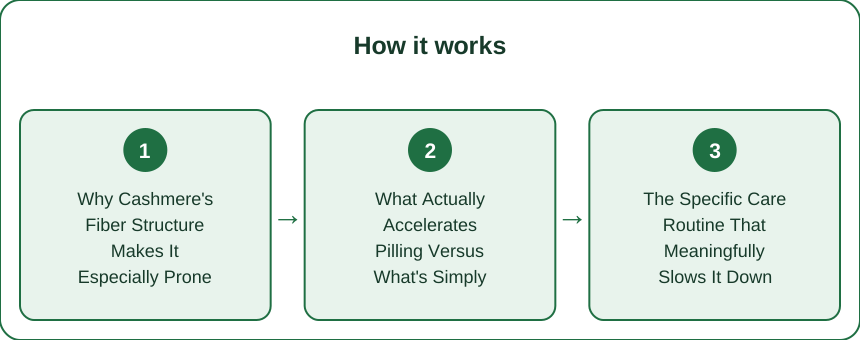
Short, fine fibers. Cashmere comes from a considerably shorter and finer fiber than typical sheep’s wool, and shorter fibers work loose and tangle into visible pills far more readily.
Softness and pilling are the same property. The fineness that produces that famous hand-feel is mechanically identical to the fineness that lets individual fibers break free. You can’t have one without the other.

Loose yarn twist. Cashmere yarn is often spun with less tight twisting specifically to preserve softness, which also lets fibers migrate to the surface more easily than a tightly twisted yarn would.
Grade genuinely matters. Fiber staple length varies across products. Shorter-staple, lower-grade cashmere pills faster and more visibly than longer-staple cashmere, care held constant.
Friction is local. High-contact areas pill first, which is why pilling appears in a predictable pattern rather than evenly — underarms, where a bag strap sits, the sides where your arms swing.
What’s normal pilling, and what’s you making it worse?
- Normal: early pilling in the first several wears as loose fiber ends settle into the yarn structure. Essentially all real cashmere does this. It isn’t a defect.
- Accelerating it: rough external friction — a coarse coat lining, a bag strap, a seatbelt across the same spot every commute.
- Accelerating it badly: machine washing. Mechanical agitation directly causes fiber breakage, and it’s the single most controllable factor on this list.
- Accelerating it badly: machine drying. Heat plus tumbling is worse than washing.
- Accelerating it quietly: no rotation. Wearing the same piece repeatedly concentrates cumulative friction instead of distributing it.
- Out of your hands: fiber grade. Two identically cared-for pieces can pill at genuinely different rates.

Myth vs Fact
Myth: Pilling means it isn’t real cashmere. Fact: It’s closer to the opposite. Real cashmere’s short, fine fibers pill readily; heavily synthetic-blended knits often pill differently or resist it. Pilling is not a fraud detector.
Myth: Expensive cashmere doesn’t pill. Fact: Better grade and longer staple pill more slowly. Nothing in the price bracket switches the mechanism off.
Myth: Freezing a sweater stops pilling. Fact: Freezing does nothing for pilling and, despite the persistent internet claim, doesn’t reliably kill moth larvae either. Proper storage does.
Myth: You should pull pills off by hand. Fact: Pulling drags out intact neighbouring fibers along with the pill, which creates the next pill. A proper fabric shaver or comb cuts them off at the surface instead.
Myth: Dry cleaning is the safest option. Fact: Occasional cleaning is fine, but frequent solvent cleaning is harsher on cashmere than careful hand washing. How often to dry clean is worth reading before defaulting to it.
What care routine actually slows it down?
Hand wash, or use a dedicated cold wool cycle. Gentle handling directly reduces the mechanical agitation that breaks fibers. Cool water, minimal movement, no wringing. Our full cashmere washing method covers the details.
Never machine dry. Air dry flat, always. Both the heat and the tumbling accelerate fiber damage well beyond what washing alone causes.
Rotate your pieces. Even a rotation of two or three distributes friction exposure instead of concentrating it. Give a sweater a day off between wears.
Use a proper fabric shaver. Regularly, gently, on a flat surface. This is maintenance, not repair — a light pass every few wears beats an aggressive session once a season.
Watch the contact points. Notice what rubs where. A different bag strap position, or a smoother coat lining, meaningfully changes how fast the underarm and hip areas go.
One honest caveat: no routine stops pilling entirely, and a piece that pills is not a piece that’s failing. A well-cared-for cashmere sweater that gets shaved twice a season can look good for a decade. The goal is managing a normal process, not preventing one.
FAQ
Should I shave a new cashmere sweater?
Wait until the first pills actually appear — usually a few wears in. Shaving pristine fabric removes nothing useful and thins the surface slightly. Once pilling starts, regular light passes are better than waiting for a heavy build-up.
Does washing cashmere more often make pilling worse?
Gentle hand washing is not the enemy; agitation is. Washing correctly every few wears is fine and arguably better than letting oils and grit accumulate, since embedded dirt increases abrasion between fibers.
Will pilling stop eventually?
It slows considerably. Once the short loose fibers near the surface have worked their way out over the first season, the rate typically drops. That’s why a well-maintained older sweater often pills less than a new one.
TL;DR:
- Cashmere’s short, fine fibers pill readily — the same property that makes it soft. Not a quality flaw.
- Loose yarn twist and shorter-staple grades both increase the rate.
- Early pilling in the first wears is normal for all real cashmere.
- Machine washing and machine drying are the biggest controllable accelerants.
- Rotate pieces, hand wash cool, dry flat, and use a fabric shaver rather than picking pills by hand.
- Pilling never stops entirely — but it slows a lot after the first season, and managed well a sweater lasts years.
Keep Reading
Style guidance in this article is general. Fit, fabric behaviour and care vary by garment and maker — always check the care label and size guide for the specific piece you own or are considering.