What the Care Label Does Not Tell You About How a Garment Will Age
Quick Answer: A care label tells you how to wash a garment, not how it will age. The four things that decide that are fibre length, fabric construction, seam allowance and colour depth — and all four are checkable in a shop in under a minute. Short-staple fibres pill, loose weaves snag, narrow seams cannot be let out, and mid-depth colours fade most visibly. None of it appears on the label.
Two jumpers with identical labels — 100% wool, hand wash, dry flat — will look completely different in two years. One will still be a jumper and one will be a felted, pilled, misshapen version of one.
The label was accurate in both cases. It simply was not answering the question anyone actually has, which is whether the thing will still be good.
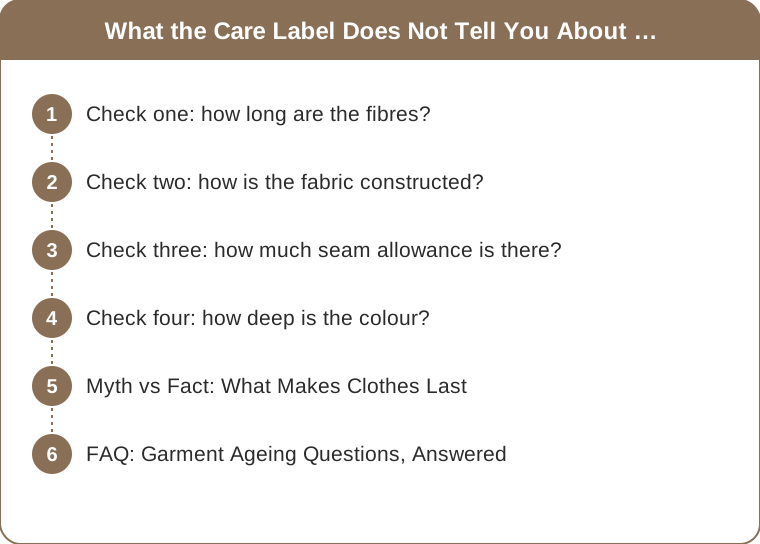
Four checks, all of which take seconds and none of which are printed anywhere on the garment.

Check one: how long are the fibres?
This is the single biggest predictor of whether a knit pills, and you can assess it by touch.
Long-staple fibres are spun from longer strands, so fewer fibre ends stick out of the yarn. Fewer ends means less pilling, because a pill is what happens when loose ends tangle together under friction.
The tactile test: run your palm firmly across the surface. A long-staple yarn feels smooth and slightly cool. A short-staple one feels slightly fuzzy or dusty, and often leaves a faint haze on your hand.
The visual test: hold the fabric up to a light source and look at the surface in profile. A halo of tiny fibres standing up from the surface means short staple.
This applies to cotton as well as wool. Long-staple cotton — sometimes labelled as such, sometimes not — makes shirts that stay crisp for years while ordinary cotton goes soft and thin.
Price correlates but does not guarantee. Plenty of expensive knits are short-staple, and the touch test does not care what the ticket says.
Check two: how is the fabric constructed?
Construction decides snagging, stretching and how the garment holds its shape, and it is entirely invisible in a product description.
For knits, look at the gauge. Tight, dense knitting resists snags and holds shape; loose, open knitting catches on everything and grows over time. Stretch a section gently between two hands — if you can see clearly through the gaps, it will snag.
For wovens, check the recovery. Scrunch a corner of the fabric in your fist for five seconds and release. Fabric that falls back smooth will not need constant ironing. Fabric that stays creased will look tired by lunchtime for the rest of its life.
Weight is not quality but it correlates with longevity. A heavier fabric of a given type generally has more material to lose before it wears through.
One specific thing to check on knitwear: the ribbing at cuffs and hem. If the rib feels slack in the shop, it is already at the end of its recovery and those cuffs will hang open within a season.
Check three: how much seam allowance is there?
This is the alteration question, and it decides whether a garment has a second life.
Turn the garment inside out and look at the side seams. A generous allowance — 1.5cm or more, neatly finished — means the piece can be let out or taken in. A narrow overlocked edge with almost nothing spare means what you have bought is what you will always have.
The same applies to hems. A deep hem can be lengthened; a narrow rolled one cannot. Trousers and skirts with 4cm or more of hem allowance are worth notably more over time.
Seam finish tells you about the maker’s intent. Bound, flat-felled or French seams indicate a garment built to last. A raw overlocked edge with loose threads indicates the opposite, regardless of the brand.
This matters more for tailoring than for knitwear, and it matters most for anything you expect to own for more than three years — coats, trousers, jackets.
The check takes ten seconds and it is the one almost nobody performs.
Check four: how deep is the colour?
Colour depth predicts fading, and mid-tones are the worst performers.
Very dark and very pale colours age most gracefully. Black fades to a soft charcoal that still reads as intentional; cream fades barely at all. Both fail slowly.
Mid-depth saturated colours are the vulnerable ones — teal, burgundy, forest green, mid-blue. They lose their intensity unevenly, and the result reads as worn rather than as a different shade.
There is a construction dimension too. Piece-dyed fabric, where the cloth is dyed after weaving, fades faster than yarn-dyed, where the threads were coloured first. Yarn-dyed fabric is usually the same colour on both faces — check the inside against the outside.
Friction points show it first: the seat of a trouser, the elbows of a knit, the shoulder line of anything hung in daylight.
Practical consequence: buy your mid-depth colours cheaper and your neutrals better. The neutrals will still be with you when the teal has moved on.
Myth vs Fact: What Makes Clothes Last
Myth: Dry clean only means better quality. Fact: It usually means the garment has a lining, mixed fibres, or a construction the maker could not guarantee through water. Plenty of exceptional garments are washable, and dry cleaning is itself hard on fabric over many cycles.
Myth: Natural fibres always outlast synthetics. Fact: For abrasion resistance, good synthetics often win. Where natural fibres win is in ageing gracefully — wool and cotton look acceptable as they wear, whereas polyester pills and then stays pilled.
Myth: A high price guarantees longevity. Fact: Price correlates with fabric quality but not reliably. The four checks above will tell you more in sixty seconds than the ticket will.
Myth: You should wash clothes less to make them last. Fact: Partly true — over-washing wears fabric — but body oils left in wool attract moths and set stains permanently. Air between wears, wash properly when it needs it, and do not leave anything stored dirty.
FAQ: Garment Ageing Questions, Answered
Can I tell if something will pill before I buy it?
Reasonably well, yes. Rub the fabric briskly against itself at a seam for a few seconds. If tiny fibres begin to gather immediately, it will pill. This is more reliable than fibre content, because a short-staple wool pills far worse than a good wool-synthetic blend.
Are blends always worse than pure fibres?
No. A small percentage of synthetic in a natural fibre often improves durability and shape recovery significantly — a wool with a few percent nylon at the heel of a sock, for instance, lasts several times longer. What is usually poor is a fifty-fifty blend chosen to reduce cost.
Which single check is most worth doing if I only do one?
The fibre-end test — palm across the surface, look for a halo against the light. Pilling is the most common reason a garment stops being worn, and it is the most predictable of the four.
TL;DR:
- Care labels cover washing, not ageing. The four things that matter are not printed anywhere.
- Feel for fibre ends — a fuzzy halo means it will pill within a season.
- Check seam and hem allowance inside out; narrow seams mean no second life.
- Buy neutrals well and mid-tones cheaply — saturated mid-depth colours fade worst.
Do the palm test on something you already own and love. Whatever it tells you about that garment is the standard worth applying to the next one you buy.
Keep Reading
Style guidance in this article is general. Fit, fabric behaviour and care vary by garment and maker — always check the care label and size guide for the specific piece you own or are considering.