Why the Zip Fails Before Anything Else on the Garment
Quick Answer: Zips fail more than any other component because they are the only part of a garment with moving parts under repeated stress, and they are where manufacturers economise most freely. Most failures are the slider wearing out rather than the teeth breaking, which is genuinely repairable and often cheap. Check for a branded slider, metal rather than moulded plastic on anything heavy, and a zip garage at the top - and have a failing slider replaced before the teeth get damaged.
A coat with years left in it, retired because the zip stopped catching at the bottom.
It is the most common way a good garment ends, and it is very often the most fixable.

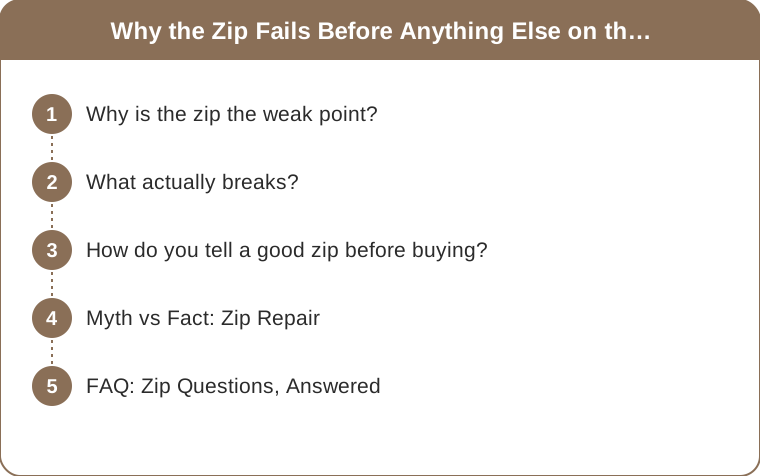
Why is the zip the weak point?
It is the only part of a garment with moving parts, and moving parts under repeated load fail before static ones do.
It takes concentrated stress. The whole tension of a closed front runs through a narrow line of teeth and one small slider.
Usage is high. A daily coat zip is operated hundreds of times a season, which is more cycles than any seam sees.
It is a bought-in component, so it is easy to substitute a cheaper one without changing anything a shopper looks at.
And it fails progressively rather than suddenly, so people adapt to a zip that catches until the day it will not close at all.
Which means it is also the failure with the longest warning period, and the one most worth acting on early.
What actually breaks?
The slider, in the large majority of cases. The two channels inside it wear and spread slightly, so it stops pressing the teeth together properly.
A zip that opens behind the slider as you close it is the classic sign, and it means the slider, not the teeth.
Teeth damage is less common and much more serious, since a bent or missing tooth usually means replacing the whole zip.
The bottom stop can pull off on a separating zip, which lets the slider come off entirely.
The pull tab breaking is cosmetic and can be replaced with anything from a proper tab to a small ring.
And fabric caught in the teeth is the most preventable cause, since a lining pulled into a zip damages both at once.

How do you tell a good zip before buying?
Look for a brand name on the slider. Reputable zip makers stamp their sliders, and an unbranded slider on an expensive coat is a genuine warning sign.
Metal teeth on heavy garments, moulded plastic on light ones - a coil zip on a heavy coat front will not hold up.
Run it up and down five times in the shop. It should move smoothly with one hand and without a catch anywhere along its length.
A zip garage - a small fabric flap at the top - protects the chin and the slider and signals a maker who thought about the detail.
Check that the zip tape is stitched flat and straight, since a wavy zip tape means the teeth are under uneven tension and will wear early.
And on a separating zip, check the box and pin at the bottom, which is where cheap zips are most obviously cheap.
Myth vs Fact: Zip Repair
Myth: a broken zip means the garment is finished.
Fact: most failures are the slider, and a slider replacement is quick and inexpensive at any alteration shop. People discard coats and boots over a repair that costs a fraction of replacing them, largely because nobody mentions that sliders are a separate part.
Myth: pliers fix a loose slider permanently.
Fact: gently squeezing a slider does temporarily restore the grip, and it is a legitimate emergency measure. It also work-hardens the metal, so it works a few times and then the slider breaks outright. Use it to get home, then replace it.
Myth: rubbing a candle on a zip is an old wives’ tale.
Fact: wax genuinely helps a stiff zip, and so does a graphite pencil. What does not help is oil-based lubricant, which attracts dirt into the teeth and makes the problem worse within weeks.
Myth: metal zips are always better.
Fact: metal is stronger and correct for heavy outerwear and jeans. On lightweight garments a good coil zip is more flexible, lighter and less likely to distort fine fabric. The mismatch, not the material, is what fails.
Myth: the zip broke because of the fabric caught in it.
Fact: a lining caught in a zip is usually a symptom of a lining cut too generously or a missing zip guard, which is a design problem. The zip is where it shows up, but replacing the zip without addressing the guard just delays it.
Myth: a stiff new zip will loosen with use.
Fact: a zip that is stiff from new is usually misaligned tape or a poor slider, and it gets worse rather than better. This is worth returning a garment over, and it is one of the few faults visible in the first minute of ownership.
FAQ: Zip Questions, Answered
How much does a zip repair cost?
A slider replacement is generally inexpensive and quick. Replacing a full zip on a lined coat costs considerably more because of the labour, not the part.
How do I know if it is the slider or the teeth?
If the zip opens up behind the slider as you close it, it is the slider. If teeth are visibly bent, missing or splayed, it is the zip.
Can I replace a slider myself?
On a non-separating zip it is a reasonable home job with a replacement slider and pliers. On a separating coat zip it is fiddly enough to be worth paying for.
What lubricant should I use?
Wax - a candle, a wax stick or a graphite pencil. Not oil, which attracts grit into the teeth and accelerates wear.
Why do boot zips fail so often?
High cycle count, dirt, and a lot of lateral stress from ankle movement. Boot sliders are among the most replaceable and most-replaced parts there are.
Should a broken zip stop me buying secondhand?
Not at all, provided the teeth are intact. A slider replacement on an otherwise excellent coat is one of the best-value repairs available.
TL;DR:
- The zip is the only component with moving parts under repeated load, and it is where makers economise most quietly.
- Most failures are the slider, not the teeth - and a zip that opens behind the slider is the telltale sign.
- Check for a branded slider, metal teeth on heavy garments, a flat straight tape and a zip garage.
- Wax or graphite for stiffness; never oil, which pulls grit into the teeth.
- A slider replacement is cheap and quick, and it saves coats and boots that people routinely discard.
The garment is rarely finished. The smallest part on it is.
Keep Reading
Style guidance in this article is general. Fit, fabric behaviour and care vary by garment and maker — always check the care label and size guide for the specific piece you own or are considering.