How to Identify Luxury Fabrics - the Six Checks That Actually Work
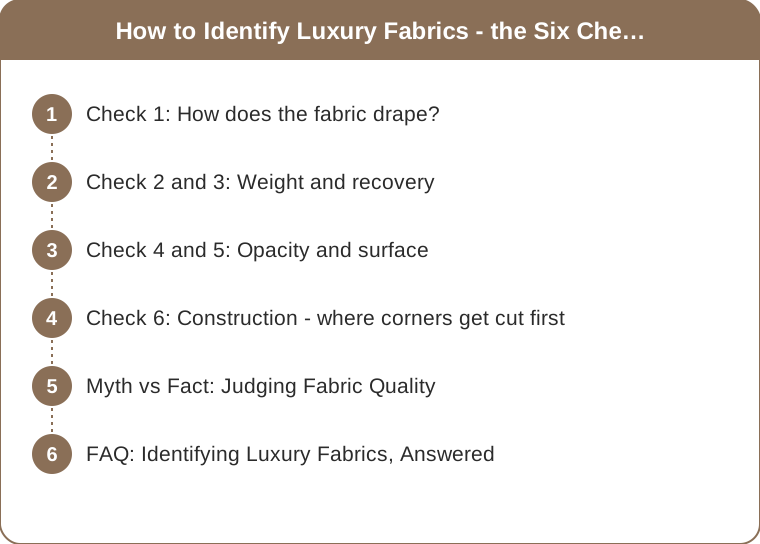
Quick Answer: To identify a luxury fabric, run six checks in this order: drape, weight, recovery, opacity, surface, and construction. Hold the fabric up and watch how it falls - luxury fabric drapes in soft continuous curves rather than folding into stiff angles. Then feel the weight relative to its thinness, crush it in your fist for five seconds and watch how fast the creases release, hold it up to the light to check density, look at the surface under angled light for even yarn and a quiet lustre, and finally check the seams, hems, and pattern matching. Fibre content is the last thing to consult, not the first.
Here is each check in detail, and what it tells you.

Check 1: How does the fabric drape?
Drape is the most reliable single indicator, and it takes two seconds. Hold a section of fabric up by one point and let it fall - luxury fabric falls in soft continuous curves, while poor fabric folds into stiff, angular planes.
This works because drape is a function of fibre quality and yarn construction. Longer, finer fibres spun into a supple yarn produce cloth that moves; short fibres and heavy sizing produce cloth that holds a shape it was never meant to hold.
The test that removes all doubt is movement. Walk two steps with the garment on - good cloth follows the body a beat behind, cheap cloth moves as a single flat unit.
Beware of stiffness that comes from finishing. Many cheap fabrics are treated with sizing or resin to feel substantial in the shop and lose it entirely after one wash - drape is what survives the wash, hand feel often is not.
Drape also explains why the same fibre varies so much. A poor-quality wool and an excellent wool can both be 100% wool; the difference in how they fall is immediate and obvious side by side.
Check 2 and 3: Weight and recovery
Weight relative to thinness is the tell that separates fine fabric from thin fabric. A luxury fabric feels denser than it looks - hold two garments of similar thinness and the better one is noticeably heavier in the hand.
This is fibre density, and it cannot be faked cheaply. More fibre per square centimetre means better opacity, better drape, better wear, and it is the single most expensive thing about good cloth.
Recovery is the five-second test that predicts the whole life of the garment. Crush a section firmly in your fist, hold for five seconds, release - good fabric relaxes most of the creasing within about thirty seconds; poor fabric keeps a sharp crease.
Linen is the honest exception. Linen creases by nature and always will, so judge linen on weight, evenness, and how the creases fall - soft and rumpled rather than sharp and papery.
Recovery predicts how the garment looks at 6pm. A dress that passes the fist test looks the same at the end of the day as at the start, which is the practical definition of quality clothing.
Do this test at the hem, not on a display sample. Hems and inner seams tell the truth, while display pieces have often been steamed within the hour.
Check 4 and 5: Opacity and surface
Hold the fabric up to a window and look through it. A dense, evenly distributed weave with no visible thin patches indicates quality; cloudy, uneven density means inconsistent yarn.
Opacity is also the most common practical failure. A white or pale garment that is transparent under daylight was made from insufficient fibre, and no amount of styling fixes it.
Now look at the surface at an angle to the light. Quality cloth has an even, quiet lustre; poor cloth has either a flat dead surface or an obvious plastic shine from high synthetic content.
Check for fibre ends standing up on the surface. Short fibre ends visible on the face of the fabric are what turn into pilling within a few wears - a smooth face means longer fibres and a tighter spin.
Colour depth is part of this. Quality dyeing produces a colour that has depth and looks the same on both faces; cheap dyeing sits on the surface, and the reverse side is visibly paler.
And rub a section against itself for ten seconds. If you can raise fuzz in ten seconds in a shop, the garment will pill comprehensively in normal wear.

Check 6: Construction - where corners get cut first
Turn the garment inside out. This is where the manufacturer stopped trying. Seam allowances under 1 cm, raw overlocked edges, and loose thread ends all indicate that the visible fabric was the only budget priority.
Check the pattern matching at the seams. A stripe or check that continues across a side seam costs real money in wasted cloth, and it is one of the most reliable indicators in existence.
Look at the lining if there is one. A lining in a substantially cheaper material than the shell tells you exactly where the money went - and a lining that is a different weight to the shell will drag and pull as the garment ages.
Buttons and zips are cheap signals. Metal or shell buttons, a smooth branded zip, and spare buttons attached cost very little but are among the first things cut on a poorly made garment.
Feel the interfacing at collars and cuffs. Fused interfacing that feels like cardboard will bubble and separate after washing; a softer, more flexible structure has been sewn rather than glued.
And check the hem depth. A deep hem of 4 cm or more means excess fabric was allowed and the garment can be altered; a 1 cm rolled hem means cloth was rationed.
Myth vs Fact: Judging Fabric Quality
Myth: Natural fibres are always better than synthetic. Fact: A high-grade technical synthetic outperforms a poor wool on nearly every measure. Fibre quality within a category matters more than the category.
Myth: Price indicates fabric quality. Fact: Price includes brand, marketing, and margin. The six checks are independent of price, which is exactly why they are worth learning.
Myth: If it feels soft, it is good. Fact: Softness is easily added with finishing treatments that wash out in two cycles. Drape and recovery survive washing; hand feel frequently does not.
Myth: 100% cotton means quality. Fact: Fibre length and spin quality vary enormously within a fibre. Two 100% cotton shirts can differ by a factor of five in how long they last.
Myth: Heavier always means better. Fact: Density relative to thinness is the signal, not absolute weight. A heavy fabric that is heavy because of coarse fibre is not a good fabric.
Myth: You need to know fibre names to judge fabric. Fact: The composition label is the last thing to check, not the first. Drape, weight, recovery, opacity, surface, and construction are all assessable by hand in ninety seconds.
FAQ: Identifying Luxury Fabrics, Answered
How can I tell if a fabric is high quality in a shop?
Run six checks: watch how it drapes, feel its weight relative to thinness, crush it for five seconds and watch the creases release, hold it to the light for even opacity, look at the surface at an angle for even lustre, and turn it inside out to check the seams.
What is the single fastest test?
Drape. Hold the fabric up and let it fall. Continuous soft curves indicate quality; stiff angular folds do not. It takes two seconds and is remarkably reliable.
Does fibre content tell me what I need to know?
Not on its own. Two garments with identical composition labels can differ enormously depending on fibre length, yarn spin, and weave density. Check the cloth by hand first, the label last.
Are natural fibres always more luxurious?
No. Quality within a fibre type varies more than between types, and a well-engineered synthetic can outperform a poor natural fibre on drape, recovery, and durability.
Why do some garments feel wonderful in the shop and disappointing after washing?
Softening finishes. Many cheaper fabrics are treated to feel substantial and soft at the point of sale, and the treatment washes out within a couple of cycles. Drape and recovery are the properties that survive.
What is the clearest sign that corners were cut?
Turn it inside out. Seam allowances under 1 cm, raw overlocked edges, a lining much cheaper than the shell, and a 1 cm rolled hem all mean the cloth budget went into what you could see.
How do I predict whether something will pill?
Look at the surface for short fibre ends standing up, and rub a section against itself for ten seconds. If you can raise fuzz in the shop, it will pill in normal wear.
TL;DR:
- Six checks, in order: drape, weight, recovery, opacity, surface, construction. Ninety seconds, no expertise required.
- Drape is the fastest and most reliable. Soft continuous curves, not stiff angular folds.
- Density relative to thinness beats absolute weight. Fine and heavy is the signal.
- The five-second fist test predicts how the garment looks at 6pm. Good cloth releases creases in about thirty seconds.
- Hold it to the light for even opacity, and look at the surface at an angle for quiet, even lustre.
- Turn it inside out: seam allowance, pattern matching at seams, lining quality, hem depth, interfacing.
- Check the composition label last. Quality varies more within a fibre type than between types.
Softness washes out. Drape and recovery do not.
Keep Reading
Style guidance in this article is general. Fit, fabric behaviour and care vary by garment and maker — always check the care label and size guide for the specific piece you own or are considering.