The Storage Mistake That Quietly Ruins Clothes Over Summer
Quick Answer: The main cause of storage damage is residual moisture and invisible body oils sealed into an airtight container. Anything stored unwashed or slightly damp in plastic develops yellowing, permanent odor, mildew, and attracts moths — whose larvae feed on the protein residue, not the wool itself. Store clean, fully dry, in breathable cotton or a ventilated box, in a cool dark place, folded rather than hung for knitwear. Airtight plastic is the single most common mistake.
You take the sweaters out in October and there are yellow patches that were not there in May, or a smell, or small holes in the exact places you never wore through.
None of that happened while you were wearing them. It happened over four months in a box, and it is almost always the same cause.

What actually damages clothes in storage?
Moisture and residue, working together in a sealed environment.
Every garment you wore carries invisible body oils, salts, and skin cells even after one wear. These are not visible and they are not smelly at the time — but over months they oxidize, and oxidation is what produces the yellow-brown patches that appear at underarms, collars, and cuffs.
Residual moisture is the accelerant. Fabric that felt dry to the touch can still hold several percent moisture, especially thicker knits, and sealed in plastic that moisture has nowhere to go. The result is mildew, permanent musty odor, and in bad cases actual fiber damage.
Moth larvae are attracted to the residue, not the fiber. This is the detail almost nobody knows — clothes moths lay eggs on protein fibers that carry food traces, sweat, or oils, and the larvae eat the fiber to get at them. A genuinely clean wool sweater is a far less attractive target than a once-worn one.
Light causes fading even in a closed room. Sunlight through a window will fade a folded stack over a summer, and the fade is uneven and permanent.
Compression sets permanent creases. Heavy stacks and vacuum bags crush fibers, and in wool and cashmere those creases can be effectively permanent.
What should I actually do before storing anything?
Wash or clean everything, without exception, including things you wore once.
This is the single most important step and it is the one most commonly skipped. A sweater worn twice looks clean and carries enough residue to yellow and to attract moths over four months.
Dry completely and then wait. Thick knits hold moisture in the core long after the surface feels dry. Lay flat for a full twenty-four hours after they feel dry before anything goes into a container.
Skip the fabric softener and starch. Softener leaves a residue that attracts pests; starch is essentially a food source and starched cotton in storage is a well-known moth and silverfish target.
Store in breathable containers. Cotton storage bags, canvas boxes, cardboard boxes with the lid loose, or acid-free tissue. Airtight plastic bins and vacuum bags trap the moisture that causes almost all storage damage.
Fold knitwear, never hang it. Hanging a wool or cashmere sweater for months stretches the shoulders permanently under its own weight.
Cool, dark, and dry for the location. Under a bed and inside a closet both work well. Attics, basements, and garages are the three worst options because all three swing in temperature and humidity.
Myth vs Fact: Clothing Storage
Myth: Vacuum bags are good for storage. Fact: They are good for transport and bad for storage. They trap residual moisture with no ventilation and compress fibers into permanent creases. Wool, cashmere, and down all suffer badly.
Myth: Mothballs are the answer. Fact: Traditional mothballs work but leave an odor that takes months to clear and involves chemicals many people would rather avoid. Cedar and lavender repel adult moths only and do nothing to larvae already present — cleanliness is what actually prevents infestation.
Myth: Dry cleaning before storage is always best. Fact: Cleaning before storage is essential; dry cleaning specifically is not always the method. Ask for the plastic bag to be removed — it traps solvent fumes and moisture, and it is one of the more common causes of storage yellowing.
Myth: If it smells fine it is clean enough. Fact: Oxidation-driven yellowing comes from residues you cannot smell at all. The stain appears months later, from something that was invisible and odorless when you put it away.
Myth: Cedar blocks last forever. Fact: Cedar oil evaporates within a year. Sanding the surface lightly restores it, and unsanded old cedar is doing nothing at all.
How do I store each kind of thing?
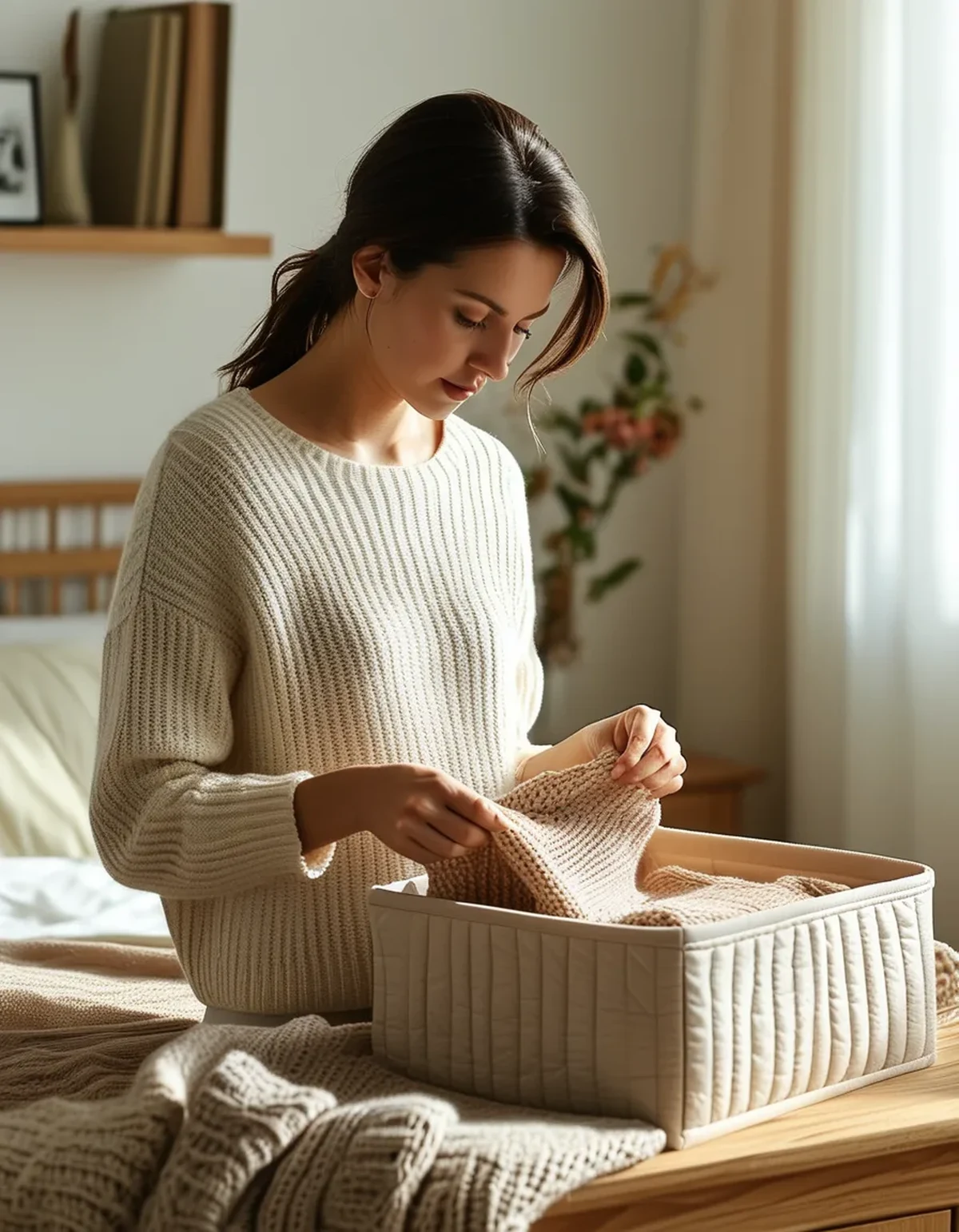
Knitwear: washed, fully dry, folded, in a breathable box with tissue between heavy pieces. Never hung, never compressed, never in plastic.
Silk and fine fabrics: clean, wrapped in acid-free tissue, stored flat and away from light. Silk yellows in light faster than almost anything and the damage is not reversible.
Leather and suede: cleaned, conditioned, and hung with space around them in a breathable garment bag. Leather needs air circulation; sealed in plastic it dries and cracks.
Down and padded outerwear: clean and loosely stored. Compression permanently damages the loft that provides the warmth, so hang it or store it loose rather than squashed.
Denim and heavy cotton: the most forgiving category by far. Clean, folded, anywhere cool and dry. It tolerates conditions the others do not.
Anything with metal hardware: check it before storing. Zips, buckles, and studs can corrode in humidity and transfer marks onto adjacent fabric. Wrap hardware in tissue if pieces are stored touching.
Label the boxes. Not for tidiness — so you do not open four containers in October and leave three of them open on the floor for a fortnight, which is how most stored wardrobes end up back in disorder.
FAQ: Storage Questions, Answered
Can I store clothes under the bed?
Yes, and it is one of the better locations — cool, dark, and stable. Use a breathable fabric or a shallow box rather than a sealed plastic tub, and check there is no damp coming from the floor.
How do I know if moisture is trapped in a stored box?
Open it after two weeks and smell it. Any hint of mustiness means moisture is present, and the whole contents need to come out and air fully before going back.
What actually prevents moths?
Cleanliness first, then air circulation, then repellents. Larvae feed on residue, so genuinely clean garments in a ventilated container are a poor target regardless of what else you add.
Should I refold stored knitwear during the season?
If it is stored for more than about six months, refolding once along different lines prevents permanent creases from setting in the same place. For a single-season store it is not necessary.
TL;DR: Storage damage is moisture and residue, sealed in.
- Clean everything before storing, including pieces worn once. Invisible oils yellow over months.
- Dry for a full twenty-four hours past the point it feels dry, especially thick knits.
- Breathable containers only. Airtight plastic and vacuum bags cause most storage damage.
- Moth larvae eat residue, not clean wool. Cleanliness prevents more than any repellent.
- Fold knitwear, hang leather, store down loose. Never compress anything with loft.
- Cool, dark, and stable — not the attic, basement, or garage.
Before the autumn swap, take one stored box out and smell it. That tells you more about how last year went than anything else will.
Keep Reading
Style guidance in this article is general. Fit, fabric behaviour and care vary by garment and maker — always check the care label and size guide for the specific piece you own or are considering.