Why Clothes Fit Differently at Home Than in the Fitting Room
Quick Answer: Four things change between the store and your home: lighting (fitting rooms are flattering and often dim), mirrors (many are tilted back a few degrees, which lengthens the body), your body (feet and midsection swell through the day and after meals), and the garment itself (display samples have been stretched by dozens of try-ons). None of these are conspiracies. All four are testable in about ninety seconds if you know what to check.
The garment was perfect. You get it home and it pulls at the hip, the length is wrong, and the color is not the color you thought you bought.
Here is what actually happened in each of those cases.

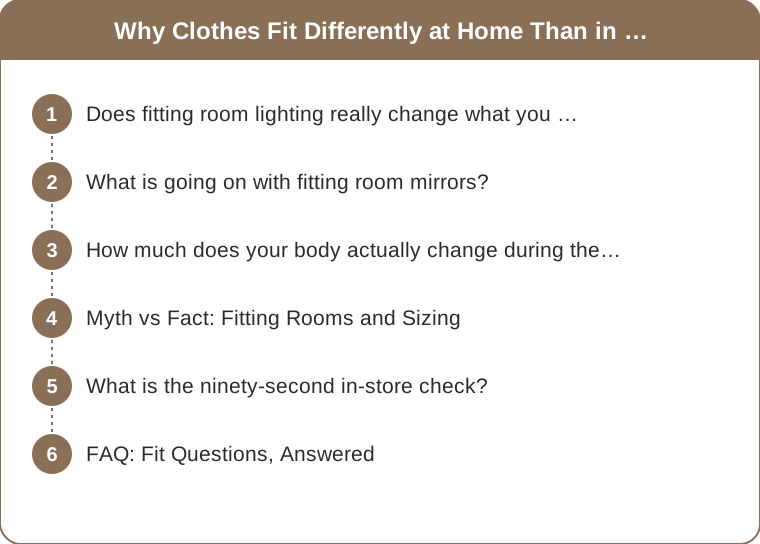
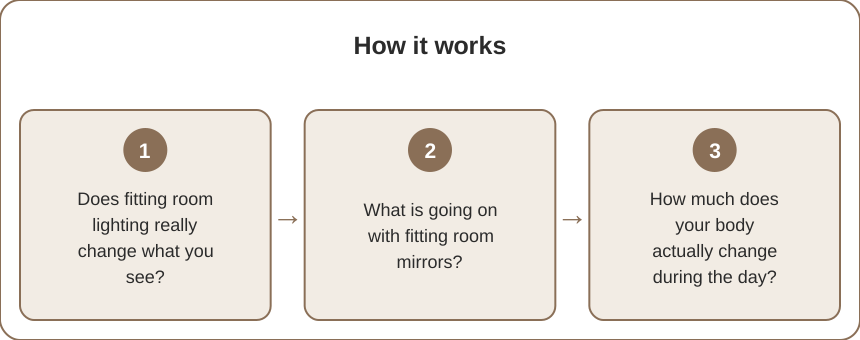
Does fitting room lighting really change what you see?
Yes, and it changes two separate things.
Color. Retail lighting is usually warm and high-intensity, which pushes everything toward richer, warmer tones. A grey that looked warm and soft under store light can read cold and flat in daylight. Anything in the beige, taupe, blush, or olive families is most affected, because those colors sit closest to the line where undertone flips.
Shadow. Overhead-heavy lighting casts shadows downward, which visually smooths the front of the body. Diffuse home lighting from a window casts sideways, which shows contour. Neither is lying — they are just different information.
The check: carry the garment out of the fitting room and look at it near the store entrance or a window, where daylight reaches. Ten seconds, and it catches almost every color surprise. If a store has no daylight anywhere, that is genuinely useful information about how carefully to buy there.
What is going on with fitting room mirrors?
Some are tilted, and the effect is real but usually smaller than people assume.
A mirror mounted with the top leaning back even three or four degrees lengthens your reflection slightly and narrows the lower body. It is a common retail fixture choice and it is not universal.
The check: stand square to the mirror and look at where your reflected feet sit relative to the actual floor line. On a tilted mirror, the bottom of the reflection will be closer to you than it should be, and stepping back changes your proportions more than it should.
The more reliable move: photograph yourself in the fitting room. A phone camera does not tilt, and a photo is what you will compare against later. It also freezes the moment so you can look at hem length and shoulder seams without holding a pose.
Take it from about six feet if you can. Arm’s-length selfies distort proportion enough to make this test less useful.
How much does your body actually change during the day?
Enough to matter for exactly two categories: shoes and waistbands.
Feet swell measurably through the day, more in warm weather, and can be up to half a size larger by evening. A shoe bought at 10am can be uncomfortably tight at 8pm.
Waist measurements fluctuate through the day and around meals by an inch or more for many people. A waistband tried on before lunch on a Saturday and worn after dinner on a Tuesday is a different experience.
What barely changes: shoulders, back width, arm length, and bust. If a jacket fits at the shoulder, it will still fit at the shoulder next week. This is why shoulder fit is the measurement worth prioritizing in tailoring — it is stable and it is the hardest to alter.
The practical rule: try shoes late in the day, and try any fitted waistband while seated as well as standing. A waistband that only works standing is a waistband you will hate.

Myth vs Fact: Fitting Rooms and Sizing
Myth: Stores use smaller sizes on labels to flatter you. Fact: Sizing has drifted larger over decades across the industry, but within a single season a brand’s sizing is generally consistent with its own chart. The variation you notice between brands is real; the deliberate manipulation within one purchase is mostly not.
Myth: The display sample is the same as the one in the box. Fact: A try-on sample in a busy store has been stretched by dozens of people, especially in knits and anything with elastane. A stretched sample can fit noticeably looser than the fresh one you take home. If a knit fits perfectly in the room, consider that the new one may be slightly tighter until you wear it in.
Myth: If it is snug now it will stretch to fit. Fact: Cotton and wool relax a little; polyester and nylon barely do. And relaxing is not the same as fitting — a garment that is tight across a fixed point like the shoulder or upper arm never becomes right.
Myth: Buying online is worse for fit. Fact: Online buying with a good return policy is often better, because you try it at home, in your light, with your shoes, at the time of day you will wear it. The friction of returning is the real cost, not the fit accuracy.
What is the ninety-second in-store check?
Seconds 1 to 20 — sit down. In the fitting room, sit on the bench for a full ten seconds and then stand. Waistbands, skirts, and anything fitted through the hip fail here and nowhere else.
Seconds 20 to 40 — reach forward and cross your arms. This is the shoulder and armhole test. If a jacket or a fitted top pulls hard across the back, no alteration fixes it.
Seconds 40 to 60 — photograph from six feet, front and side. Check hem length, shoulder seam placement, and where the waist actually falls.
Seconds 60 to 80 — walk out into daylight. Color check, and look at the fabric for see-through under real light.
Seconds 80 to 90 — check the seam allowance inside. Turn the side seam out and look at how much fabric is there. Under half an inch means this garment can never be let out, which is worth knowing before you buy something you hope to keep for years.
None of this requires expertise, and it catches almost everything that turns into a return.
FAQ: Fit Questions, Answered
Should I bring my own shoes when trying on trousers?
Yes, and it is the single most useful thing on this list. Hem length is meaningless in whatever you walked in wearing if that is not what the trousers will be worn with.
What time of day is best for shopping?
Late afternoon for anything involving feet or a waistband. Morning is fine for tops, jackets, and outerwear, since those measurements are stable.
Is it worth buying two sizes to compare at home?
If returns are free and easy, yes — comparing at home in your own light beats any fitting room. If returns cost money or effort, do the ninety-second check instead.
TL;DR:
- Store lighting shifts color, especially in beige, taupe, blush, and olive. Check near daylight before buying.
- Photograph yourself from six feet — a camera does not tilt and a mirror might.
- Feet and waistbands change through the day; shoulders and back width do not.
- Sit down, reach forward, and check the seam allowance. Ninety seconds catches almost every return.
The next time something fits perfectly in a fitting room, do the sit test before you decide. It is the single check that saves the most returns.
Keep Reading
Style guidance in this article is general. Fit, fabric behaviour and care vary by garment and maker — always check the care label and size guide for the specific piece you own or are considering.